A finished robot is not a finished accounting explanation
Kenzie Robotics asks students to trace production and document handoffs, then justify a control weakness, its risk and a workable remedy. Its teaching design is worth examining, although the reported evidence concerns students’ perceptions rather than demonstrated accounting competence.
Save this article to return to when it is useful in your teaching.
Materials can reach production without their use reaching the accounting records. For a hypothetical classroom illustration, suppose raw materials arrive at a work centre, but the issue is not recorded in the relevant inventory and production-cost records. Construction can continue while inventory records are inaccurate and production-cost records incomplete. A finished product does not tell you whether students can explain both movements: the materials and the information about their use.
Kenzie Robotics, a teaching case by Juergen Sidgman and Veena L. Brown, gives students something specific to trace. Its flowcharts distinguish issuing materials to work centres from updating inventory and production-cost records. A materials requisition connects those actions. Beyond watching the robot take shape, students must follow where the document goes, who acts on it and which record changes.
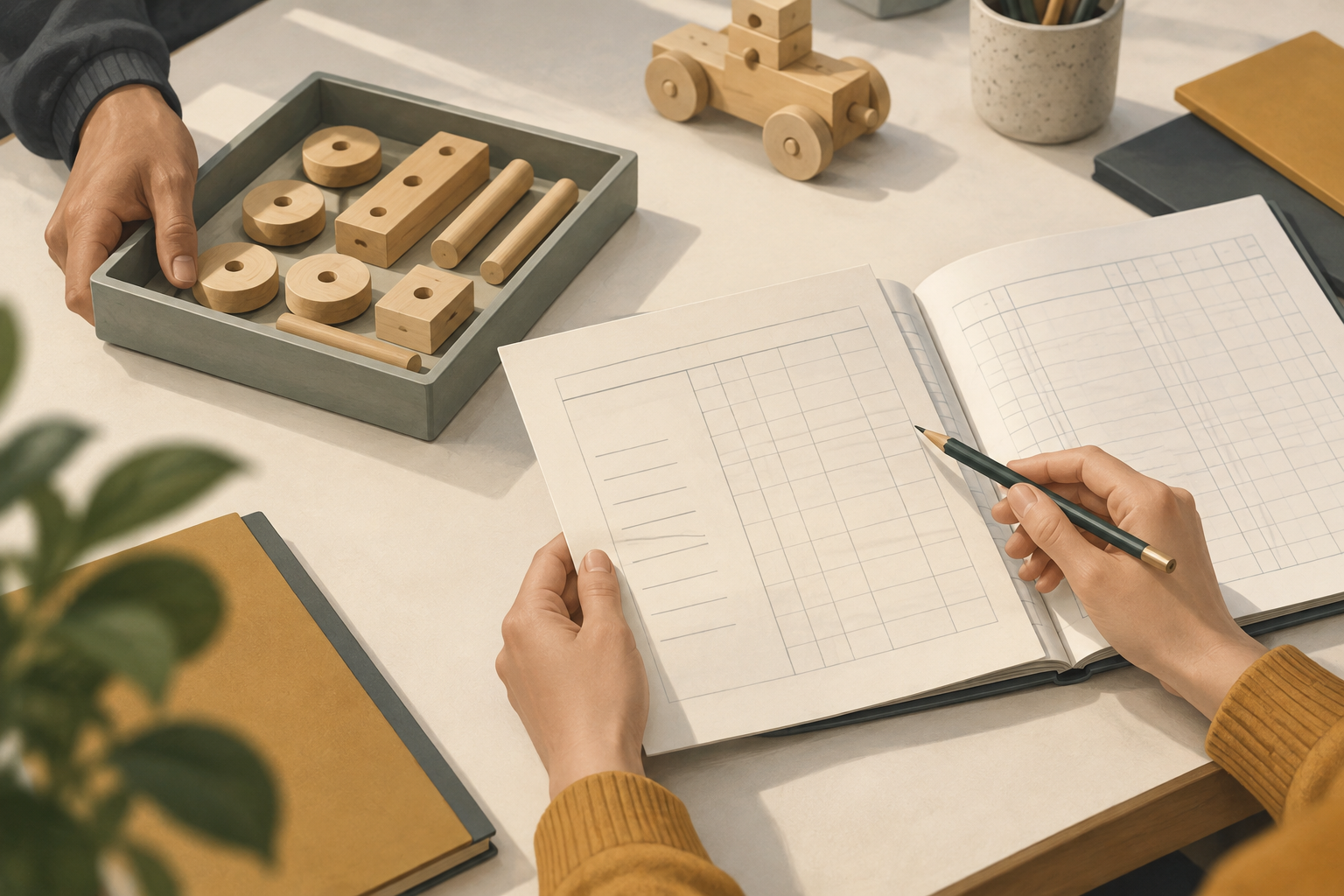
The current design puts that tracing inside three connected tasks: an individual process narrative, a teacher-guided production simulation and an individual control memorandum. Building one toy robot supplies observations for the final explanation, rather than being the endpoint.
A gap is a question before it is a finding
The case follows preparatory instruction and assumes familiarity with process diagrams and internal controls. Students first explain management’s flowcharts in a narrative covering the sequence of activities, document handling and information flow. During the simulation, they take departmental roles in production planning, work centres, the storeroom, warehouse and accounting functions. They then compare their initial account with what happened.
The crucial instruction governs what they can report afterward. When a suspected weakness comes from an omission in the initial flowcharts, students must confirm it during the simulation before including it in their memorandum. If the gap was not evident in the simulation, it belongs among the limitations of their initial documentation, not among findings about the company’s process.
For the teacher, this changes “What control is missing?” into “What did you observe that supports that conclusion?” Students are asked to distinguish an incomplete description from a deficient process, rather than turn every unexplained handoff into a reported weakness.
The memorandum then asks them to connect each specific weakness to what could go wrong and a practical mitigating control. Recommendations must fit the fictional company’s existing people, processes and resources. Hiring staff, buying a new system or making major infrastructure changes is outside the task.
Returning to the hypothetical materials issue, “improve documentation” would leave much unexplained. A useful response would identify the recording failure, connect it to inaccurate inventory and incomplete production-cost records, and justify who could check the document handoff and resulting update within existing roles. This illustrates the requested reasoning; it is not an official case solution.
Choose the design for the explanation
The individually written memo follows guided group work and a shared class debrief. It gives teachers an explanation to inspect, not proof of later unaided capability. Across 12 accounting-course sections at three US public universities, activities were combined differently and refined over time. The reported outcomes concern students’ perceived knowledge and satisfaction, not assessed assignment results. The case therefore offers a concrete reasoning task to consider, rather than a proven improvement in accounting competence.
Adopting the full sequence also requires more than a spare class period. The authors estimate about 90 minutes to prepare materials and documents, plus supply acquisition, a 60–75-minute preparatory lecture, a 75–90-minute simulation and approximately four hours of students’ outside-class work. Acquisition time is not estimated; multiple groups may need more preparation and supplies.
Check supporting-file access before scheduling. Templates and simulation documents are listed as supplements, but their current availability is unconfirmed. Separate Teaching Notes are restricted to eligible subscribers and, according to the article, deferred until journal-issue publication.
Choose the sequence for the accounting explanation you want students to produce. The decisive question is not whether they finished the robot, but whether their memorandum connects an observed weakness to a concrete consequence and a response they can justify.
Behind the researchOptional study details
The authors report implementations between 2021 and 2025 in undergraduate and graduate accounting information systems, undergraduate cost accounting and graduate auditing courses. They acknowledge early difficulties with listening while taking notes and describe revisions, including fewer seeded weaknesses, clearer documents and additional visual aids. The pooled feedback therefore covers an evolving case rather than a uniform test of the current sequence. No comparison teaching condition, delayed assessment or test on a different production problem is reported.
For planning, the authors divide preparation into approximately one hour of cutting and sorting physical materials and 30 minutes of printing and cutting documents. They estimate about two hours outside class for the initial process narrative and another two hours for the control memorandum. For the full sequence, they recommend giving students one week after the simulation to revise the narrative and complete the final analysis. These are implementation estimates, not independently timed requirements.